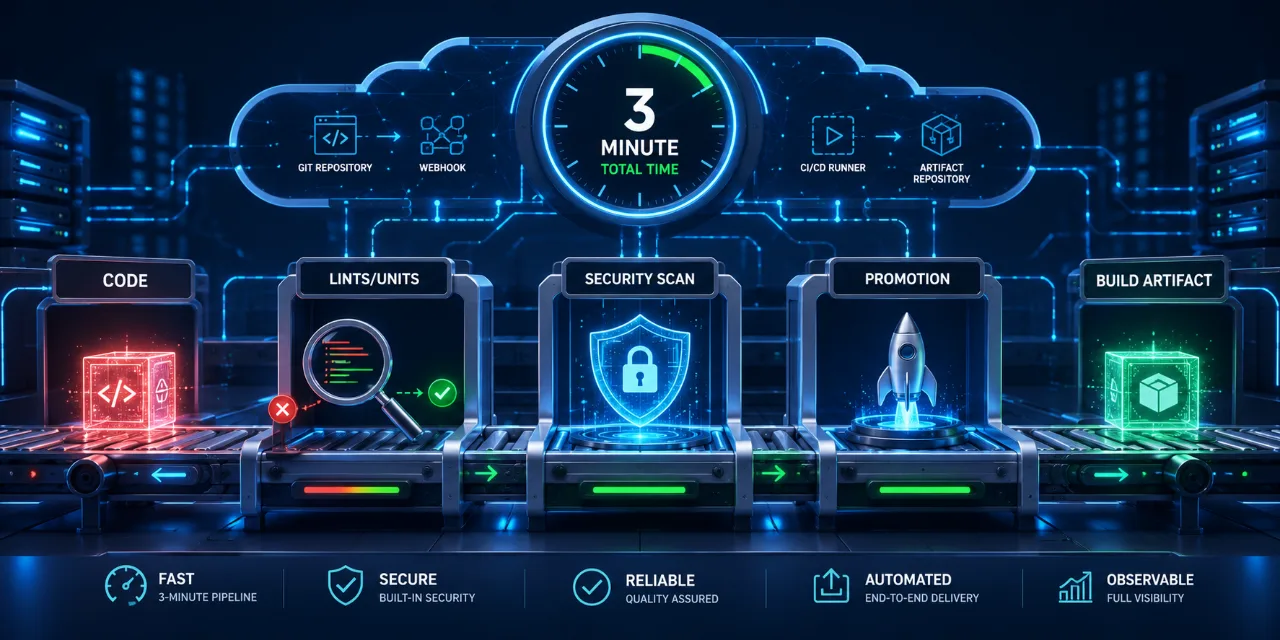
The Hidden Tax on Developer Velocity
Ask any software engineer what kills their daily productivity, and they won’t tell you it's writing complex algorithms. They will tell you it is the waiting.
Waiting for a code review, waiting for local environments to spin up, and—most notoriously—waiting for the CI/CD pipeline to turn green.
What started as DevOps’ greatest promise (automating manual deployment chaos into deterministic precision) has, in many fast-growing organizations, quietly mutated into a massive bottleneck. When builds take 45 minutes to compile, flaky tests trigger random failures, and deployment approvals require manual multi-department sign-offs, your pipeline isn't accelerating delivery—it’s charging a steep tax on your engineering velocity.
To build a high-performing engineering culture, you must treat your CI/CD pipeline not just as an operations script, but as a core product that serves your developers.
The 3 Core Friction Points of Legacy Pipelines
If your deployment process feels sluggish, it typically boils down to three architectural mistakes.
1. The "Kitchen Sink" Testing Strategy
Testing is non-negotiable. However, running your entire, heavy end-to-end (E2E) regression test suite on every single minor commit is a recipe for pipeline paralysis. When developers have to wait nearly an hour to see if a simple UI padding fix broke the system, they stop merging frequently—instantly defeating the core philosophy of Continuous Integration.
2. Environment Drift and Mutation
Are you still deploying artifacts that are built "on the fly" during the deployment step? If your staging environment behaves differently than production because of minor version mismatches or ad-hoc patches, you suffer from environment drift.
3. Over-Privileged Pipelines & Static Secrets
Your build pipeline is production-adjacent infrastructure; it holds the keys to almost everything you care about. Hardcoding long-lived API keys, using static cloud credentials in your secret store, or allowing unchecked third-party dependencies to run without SHA-pinning compromises both safety and velocity. A single security breach will freeze your entire delivery pipeline for days, if not weeks.
How to Architect a High-Velocity CI/CD Engine
Reclaiming your deployment velocity requires shifting from a "run everything always" mentality to a modern, highly optimized delivery architecture.
# A Modern, Fast-Failing CI/CD Workflow Paradigm
name: Optimized Delivery Pipeline

on:
  push:
    branches: [ main ]
  pull_request:
    branches: [ main ]

jobs:
  # Stage 1: Fast Feedback Loop (Fail Fast)
  validate:
    runs-on: ubuntu-latest
    steps:
      - uses: actions/checkout@v4
      - name: Install & Cache Dependencies
        uses: actions/setup-node@v4
        with:
          cache: 'npm'
      - name: Run Linters & Light Unit Tests
        run: |
          npm ci
          npm run lint
          npm run test:unit -- --maxWorkers=50%
Shift Left and Layer Your Tests
Organize your testing suite into layers:
Layer 1 (The Gatekeeper): Run fast, lightweight unit tests, syntax checks, and linters on every commit. This should take under 3 minutes.
Layer 2 (The Validator): Run integration tests and security scans (like SAST and dependency analysis) only on pull requests or merges.
Layer 3 (The Deep Dive): Save massive end-to-end, UI, and performance regression suites for scheduled nightly runs or pre-release release gates.
Build Once, Promote Everywhere
A foundational rule of continuous delivery is that the compilation step must happen exactly once. Build your deployable artifact (e.g., a Docker image) in the early stages, version it, and push it to a secure registry. Use environment variables to inject configurations into that same immutable artifact as it progresses from staging to production. This completely eliminates artifact drift.
Eliminate Long-Lived Secrets via OIDC
Stop saving permanent IAM or cloud provider credentials in your repo settings. Utilize OpenID Connect (OIDC) federated identities. By allowing your CI platform to exchange short-lived, single-use tokens with your cloud infrastructure, you drastically limit your attack surface without introducing manual approval roadblocks.
Velocity is a Competitive Advantage
At the end of the day, your CI/CD pipeline is the nervous system of your engineering organization. When it is fast, secure, and deterministic, developers merge small changes often, bugs are caught early, and customer value is delivered daily.
If your team is currently afraid to deploy on Fridays, it isn’t a culture problem—it’s a pipeline architecture problem. By modularizing your stages, caching ruthlessly, pinning dependencies, and utilizing immutable builds, you can transform your release process from a stressful bottleneck into a silent, competitive advantage.
#ci-cd#devops#software-engineering#developer-velocity#automation